
VTech VM819 vs Infant Optics DXR-8 PRO — What 6,471 Parents Say (2026)
Both of these baby monitors do the same headline thing: they show you the crib without putting the crib on the internet. No app, no account, nothing for a stranger to log into. After that they could hardly be less alike. The VTech VM819 is $79.99. The Infant Optics DXR-8 PRO is $349.99 — $270 more for a bigger screen and, crucially, a camera you can actually steer from the couch. We read 6,471 verified Amazon.ca parent reviews across the two to work out when that $270 buys something real and when it buys you nothing at all.
The short version, if you only want one sentence: If your baby stays where you put them, the VM819 gives you a screen, night vision and a temperature readout for eighty dollars and the $270 upgrade is hard to justify. The moment your baby rolls, crawls or climbs — or the moment a white-noise machine starts drowning out the audio — the DXR-8 PRO is the one that still works, because its camera pans, tilts and zooms from the parent unit and its noise filtering is the feature buyers name most often.
Quick verdict at a glance
| VTech VM819 | Infant Optics DXR-8 PRO | |
|---|---|---|
| Price (Amazon.ca, Aug 2026) | $79.99 CAD | $349.99 CAD |
| Parent verdict | 8.1 / 10 | 8.8 / 10 |
| Amazon.ca rating | 4.3 ★ · 397 ratings | 4.6 ★ · 6,074 ratings |
| Five-star share | 68% | 82% |
| Rated 3 ★ or lower | 20% | 10% |
| Screen | 2.8" | 5", 720p |
| Camera control | Fixed — no remote pan, tilt or zoom | Pan, tilt and zoom from the parent unit |
| Lenses | Fixed lens | Interchangeable zoom + wide-angle |
| Wi-Fi or app | None — VTech secure RF | None — 2nd-gen FHSS closed circuit |
| Night vision | Infrared | Infrared |
| Audio handling | Standard | Active Noise Reduction |
| Rated range | Up to 1,000 ft | Owners report whole-home coverage |
| Room temperature | Yes | Yes — but buyers say it reads well off |
| Extras | Eight lullabies, two-way talk | Two-way talk |
| Watch out for | Menu beep that cannot be silenced | The price, and occasional dropouts |
Who each monitor is actually for
💰 VTech VM819 — a screen and night vision for eighty dollars
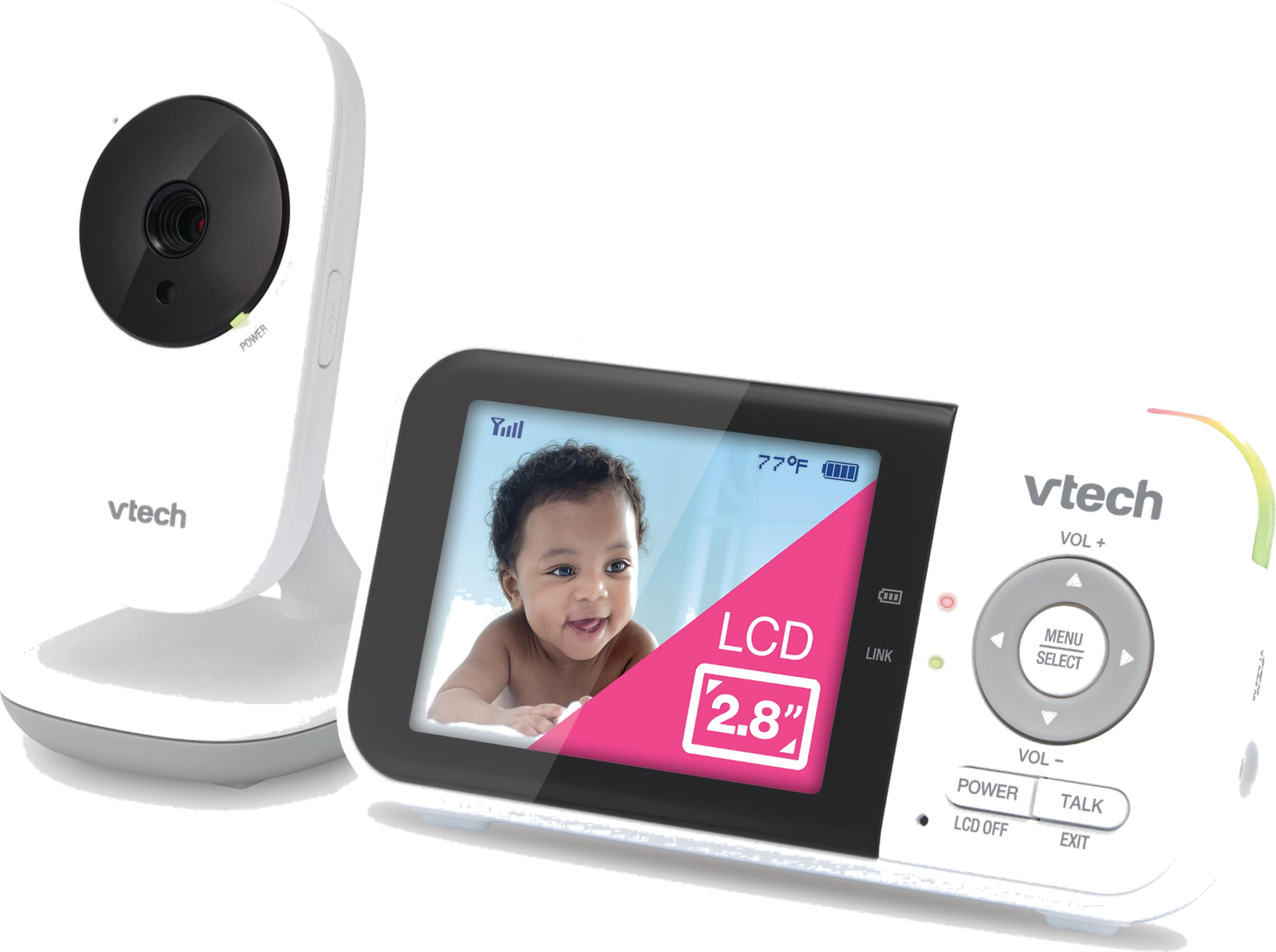
The VM819 answers a narrow question well: how little can you spend and still see the crib without an app? It carries 4.3 ★ across 397 Amazon.ca ratings, 68% of them five-star, and packs a 2.8-inch parent screen, infrared night vision, two-way talk, a room-temperature readout and eight lullabies onto VTech’s own secure RF link — no account, no internet. Its buyers are unusually clear about why they chose it: privacy and hack resistance were the deciding factor rather than a bonus. Portability is the next-loudest theme — owners describe carrying the parent unit room to room, outside while gardening and into the car, helped by a screen-off sound-activated mode that wakes the unit when the baby stirs.
Pick this if: your baby sleeps in a crib and stays in one spot, the budget matters, and you want night vision without an app. Its two documented frustrations both land at night and are covered in full below: the camera cannot be moved from the parent unit, and the menu beeps on every selection even with the volume muted.
🏆 Infant Optics DXR-8 PRO — the one you buy when the baby moves
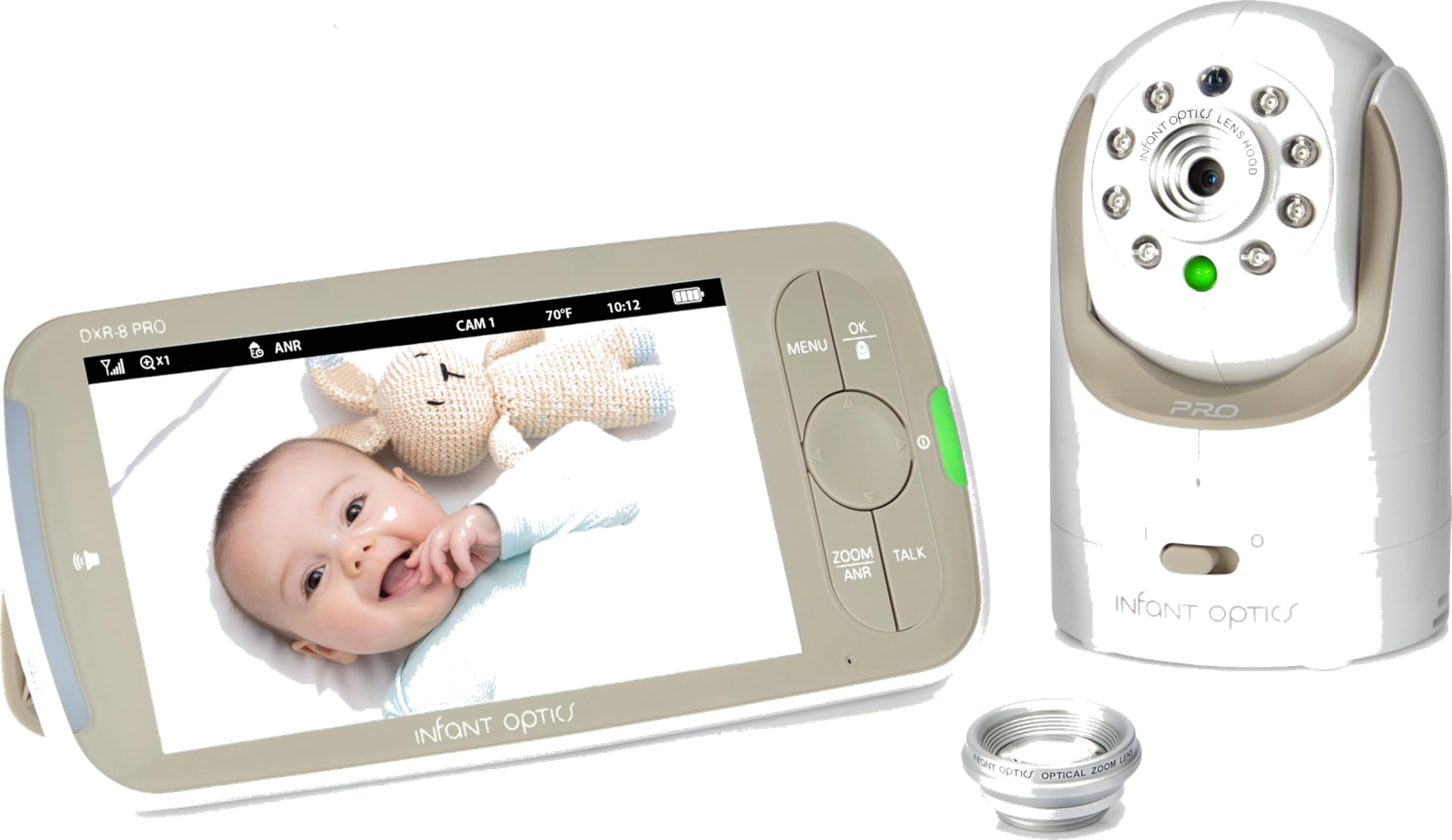
The DXR-8 PRO is the premium end of the no-Wi-Fi category and the reviews back the price up: 4.6 ★ across 6,074 Amazon.ca ratings, 82% five-star, 90% at four or five. It pairs a 5-inch 720p parent unit to the camera over a second-generation FHSS closed-circuit link, and adds the three things the VM819 has no answer for — remote pan, tilt and zoom; interchangeable zoom and wide-angle lenses; and patented Active Noise Reduction that filters nursery fans and white noise so you hear the baby rather than the room. Praise across the five-star reviews is remarkably consistent: a sharp bright screen, range that covers the whole house, and a parent unit that lasts the night. One owner reported the battery still at half in the morning; another, on their third monitor, described the picture as clear and strong across the whole house.
Pick this if: your baby is mobile, your nursery runs a sound machine or a fan, or you simply want the deepest evidence base in the no-Wi-Fi category. You are paying a clear premium for it, and you should treat the built-in thermometer as decorative — both covered below.
⚠️ One number to read carefully. The DXR-8 PRO carries 6,074 Amazon.ca ratings; the VM819 carries 397. Both averages are real, but a 4.3 drawn from 397 buyers is a thinner and much younger evidence base than a 4.6 drawn from six thousand. Where the two disagree below, weight them accordingly — and treat the VM819’s score as the one more likely to move.
Head-to-head on the four things parents actually care about
1. Can you move the camera without getting out of bed?
The DXR-8 PRO wins, and this is the whole ballgame. The VM819’s camera is fixed: wherever you physically mount it is where it points, forever. That is not a complaint we went looking for — its own five-star owners raise it, one writing “you can’t move the camera with the screen. So where ever you place it, hopefully it’s in a good spot!” For a newborn in a crib that is a shrug. For a baby who rolls to the far end of the mattress, crawls, or stands up in the corner, it means the screen shows you an empty patch of sheet and you get up anyway — which is the exact chore you bought a video monitor to avoid.
The DXR-8 PRO pans, tilts and zooms from the handheld unit, and takes a wide-angle lens for rooms where one fixed frame was never going to cover it. If you expect to still be using this monitor when your baby is a toddler, this round alone can justify the gap.
2. Night-time usability — the thing that actually wakes you
The DXR-8 PRO wins, on one specific and permanent flaw. VM819 reviewers at four and three stars both flag the same thing: selecting anything from the menu “makes an annoying beep sound when you select the room, regardless of the volume being muted,” with one owner adding it is “great for disturbing sleeping spouses.” A critical reviewer also reports that the lowest screen brightness is still far too bright, and that a blinking LED on the camera is aimed at the baby. None of that is a defect you can return — it is how the unit is designed.
The DXR-8 PRO’s night story is the opposite: its most-repeated praise is a screen that is bright and sharp when you want it, a battery owners describe as lasting the night with charge to spare, and Active Noise Reduction that strips out the fan or sound machine so a real cry actually reaches you. If you share a bedroom, or either parent is a light sleeper, weight this round heavily.
3. Range, privacy, and what happens when the internet drops
A draw — and it is the reason to buy either of them. Neither touches your home network: the VM819 runs on VTech’s own secure RF and is rated to 1,000 ft line-of-sight; the DXR-8 PRO runs a second-generation FHSS closed-circuit link with no app and no account. There is nothing for a remote attacker to reach on either, and buyers of both say that was the deciding factor rather than a nice-to-have. On coverage, owners of both describe the same real-world result — a signal that holds across a whole house and out into the yard — and monitoring that simply continues when the Wi-Fi does not.
The flip side is identical too: neither lets you check the nursery from work. If that matters, you want a Wi-Fi monitor and a different set of trade-offs.
4. Price — and what the critical minority says
The VM819 wins, and it is not close. $79.99 against $349.99 is a $270 gap, and $270 buys a lot of other things a new baby needs. The DXR-8 PRO’s own critics say so out loud: “The price is expensive. It works well — but for that money there is no WiFi app or remote viewing like some other monitors offer.” That is a fair hit. You are paying premium money for a deliberately offline device.
What you get for it shows up in the risk numbers. About 20% of VM819 buyers rated it three stars or lower, against about 10% for the DXR-8 PRO — half the share of unhappy buyers, across fifteen times as many of them. And the two sets of complaints differ in kind. The VM819’s are design decisions: the fixed camera, the beep, the brightness. They will never be fixed and they affect every unit. The DXR-8 PRO’s are a wonky temperature sensor several degrees out, and a minority reporting the parent unit losing its link to the camera — one owner wrote that it “was working fine for the first week, and now the monitor keeps losing its connection.” That is a unit-level fault a return can solve; a design choice is not.
Verdict by use case
These two share a network-free design and almost nothing else, so the answer turns on your baby, your nursery and your budget — not on the scores.
When your baby is a newborn who stays put
VTech VM819. A fixed camera is not a limitation when the baby does not move out of frame, and a screen with infrared night vision and a temperature readout for $79.99 is genuinely a lot of monitor. Buy the cheap one and spend the $270 elsewhere.
When your baby rolls, crawls or climbs
Infant Optics DXR-8 PRO. Pan, tilt and zoom from the parent unit is the single feature the VM819 cannot answer, and its own buyers name the fixed camera as the caveat. A picture of where your baby used to be is worth very little at 3am.
When the nursery runs a fan or a sound machine
Infant Optics DXR-8 PRO. Active Noise Reduction is built for exactly this and it is a recurring theme in its praise. A monitor that faithfully transmits your white-noise machine is a monitor you will end up muting.
When you share a bedroom, or one of you is a light sleeper
Infant Optics DXR-8 PRO. The VM819’s menu beep cannot be silenced even with the volume muted, its minimum brightness is reported as still too bright at night, and a blinking camera LED points at the baby. Those are the three things most likely to make you resent a monitor at 2am.
When the budget is the constraint
VTech VM819. $270 is a real difference, not a rounding error, and the VM819 still delivers the thing that makes this category worth buying: a video feed with nothing attached to the internet.
When you want the safest bet on the evidence
Infant Optics DXR-8 PRO. 4.6 ★ across 6,074 ratings, 82% five-star, and half the share of unhappy buyers. The VM819 may well settle in the same place — but at 397 ratings it has not yet had to prove it.
When you want to check the nursery from your phone
Neither. Both are deliberately network-free, which is the entire point of them — a Wi-Fi monitor is the category you actually want, and you would be trading away the privacy these two are built around.
When you want a reliable nursery thermometer
Neither, on the DXR-8 PRO’s evidence at least — its owners are blunt that the built-in reading is “so far off all of the time.” Both units display a room temperature; if that number is going to drive a decision about bedding or a heater, buy a $15 standalone thermometer and trust that instead.
The honest weaknesses we won’t hide
We have an aggregation rule: if a complaint shows up in helpful-vote-weighted critical reviews, it goes in the writeup. Buyers trust sites that show the downsides.
| Monitor | What you should know going in |
|---|---|
| VTech VM819 | The camera cannot be panned, tilted or zoomed from the parent unit — raised by its own five-star reviewers as the main caveat, and a dealbreaker once a baby is mobile. The menu beeps on every selection and cannot be silenced even with the volume muted, repeatedly described as a night-time problem. A critical reviewer reports the lowest screen brightness is still far too bright, and that a blinking LED on the camera points at the baby. Its 4.3 ★ and 68% five-star share both sit below the DXR-8 PRO’s, and rest on 397 ratings rather than six thousand — about 20% of buyers rated it three stars or lower. |
| Infant Optics DXR-8 PRO | It is expensive for a monitor with no app, and its own buyers say so: “for that money there is no WiFi app or remote viewing like some other monitors offer.” The built-in temperature sensor is widely reported as reading several degrees off — treat it as decorative. A minority report the parent unit intermittently losing its connection to the camera, in at least one case starting after the first week. And like the VM819 it cannot be viewed remotely, by design. |
Read the full reviews
- Full VTech VM819 review — 397 parents, 4.3 ★, the budget no-Wi-Fi video story in depth
- Full Infant Optics DXR-8 PRO review — 6,074 parents, 4.6 ★, the premium no-Wi-Fi story in depth
- Best no-Wi-Fi baby monitors in Canada — the wider case for keeping the nursery off the internet
- Best baby monitors in Canada — where these land against the Wi-Fi options
Buy on Amazon Canada
Prices shown were recorded on Amazon.ca in August 2026 and move often — check the current price before buying. As an Amazon Associate we earn from qualifying purchases, at no extra cost to you; full affiliate disclosure here. Scores are summarised from verified buyer reviews, not from hands-on testing. No sponsorships, ever.
Frequently asked questions
Is the Infant Optics DXR-8 PRO worth $270 more than the VTech VM819?
It depends almost entirely on whether your baby stays in one spot. For a newborn in a crib, the VM819 delivers the same core promise — a video feed with no app and no internet — for $79.99 against $349.99, and the upgrade is hard to justify. Once a baby rolls, crawls or climbs, the DXR-8 PRO’s remote pan, tilt and zoom becomes the difference between seeing your baby and seeing an empty patch of mattress, and its Active Noise Reduction matters if the nursery runs a fan or sound machine.
Do either of these baby monitors need Wi-Fi or an app?
No. Both are deliberately network-free. The VM819 uses VTech secure RF transmission and the DXR-8 PRO uses a second-generation FHSS closed-circuit link. There is no app, no account and no internet connection involved, which is the main reason buyers of both models say they chose them. Owners of both report monitoring continuing normally when their home internet drops. The trade-off is that neither can be checked remotely from a phone.
Can you move the VTech VM819 camera from the parent unit?
No, and it is the most consistent criticism in its reviews, raised by five-star owners as often as by critical ones. The camera stays pointed wherever you physically mount it. The Infant Optics DXR-8 PRO does pan, tilt and zoom from the handheld parent unit, and also accepts interchangeable zoom and wide-angle lenses, which is the main structural difference between the two.
Is the temperature reading on these monitors accurate?
Not on the DXR-8 PRO, according to its own buyers — the built-in sensor is repeatedly reported as reading several degrees off, with one owner writing that it is “so far off all of the time.” Both units display a room temperature and both are useful as a rough indicator, but if the number is going to drive a decision about bedding or a heater, a cheap standalone thermometer is the more reliable instrument.
Which monitor has the better track record?
The Infant Optics DXR-8 PRO, by a clear margin: 4.6 stars across 6,074 Amazon.ca ratings with 82% five-star, against the VM819’s 4.3 stars across 397 ratings with 68% five-star. About 10% of DXR-8 PRO buyers rated it three stars or lower, against roughly 20% for the VM819. Sample size matters here too — a 4.3 average drawn from 397 buyers is a much thinner and younger evidence base than one drawn from six thousand, so the VM819’s score is the more likely of the two to move.