
VTech DM221 vs VM819 (2026): Do You Actually Need the Screen?
Two VTech baby monitors, two dollars apart, and one real question between them: do you need to see the room, or only hear it? The VTech DM221 is audio only. The VTech VM819 adds a 2.8-inch screen with night vision. Neither touches your Wi-Fi, neither wants an app, and neither asks you to make an account. We read 21,219 verified parent reviews across both to work out which one belongs on your nightstand — and for a lot of families it is not the one with the screen.
The short version, if you only want one sentence: If your baby sleeps in a crib and stays put, the VM819 is remarkable value — a screen, infrared night vision, room temperature and lullabies for about two dollars more. If your baby rolls, crawls or climbs, the VM819’s camera cannot follow them and you are paying for a view of an empty corner — buy the DM221, whose 4.5 ★ sits on 20,822 ratings against the VM819’s 397.
Quick verdict at a glance
| VTech DM221 (audio) | VTech VM819 (video) | |
|---|---|---|
| Price (Amazon.ca, Aug 2026) | $78.04 CAD | $79.99 CAD |
| Parent verdict | 8.3 / 10 | 8.1 / 10 |
| Amazon.ca rating | 4.5 ★ · 20,822 ratings | 4.3 ★ · 397 ratings |
| Five-star share | 75% | 68% |
| Rated 3 ★ or lower | 11% | 20% |
| What you see | Nothing — audio only | 2.8" screen, infrared night vision |
| Wi-Fi or app | None — encrypted DECT 6.0 | None — VTech secure RF |
| Rated range | Up to 1,000 ft | Up to 1,000 ft |
| Two-way talk | Yes | Yes |
| Extras | Vibrating sound alert, night light, five-light sound display | Room temperature, eight lullabies |
| Camera control | Not applicable | Fixed — no remote pan, tilt or zoom |
| Off-charger runtime | Roughly 3–4 hours | Screen-off sound-activated mode extends it |
| Watch out for | A minority report receivers failing | Menu beep that cannot be silenced |
Who each monitor is actually for
🏆 VTech DM221 — for range, sensitivity and a much deeper track record
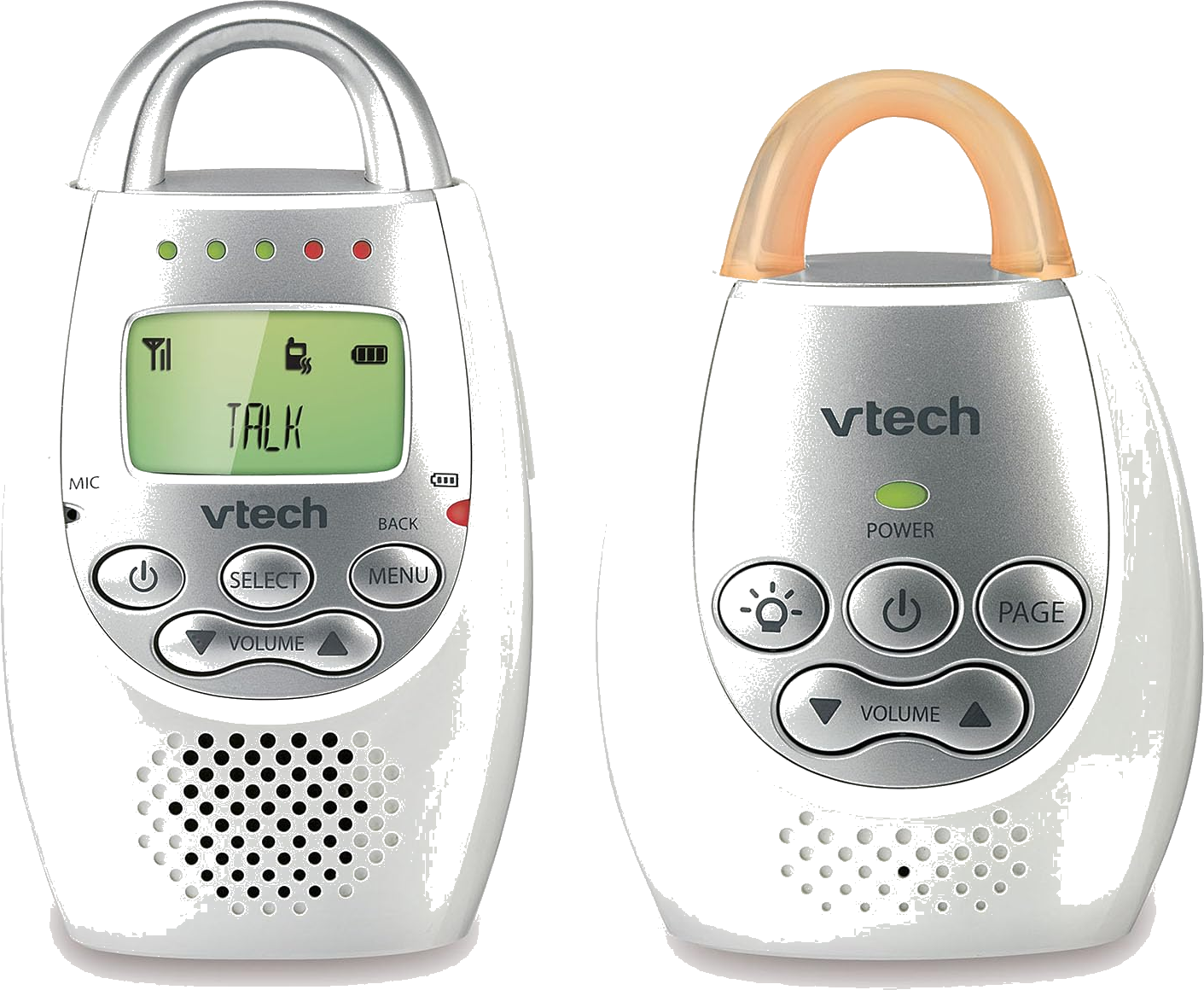
The DM221 is the higher-rated of the two and it is not close on evidence: 4.5 ★ across 20,822 Amazon.ca ratings, 75% of them five-star, with 89% at four or five stars — unusually steady for a product this old. Buyers praise two things over and over. First, independence from the network: one owner wrote that these “don’t rely on your internet connection — they work even when that’s down,” and several switched after a Wi-Fi camera dropped out mid-nap. Second, sensitivity and reach: parents describe hearing “the quietest whisper” at a middle volume setting, and holding the signal from a second floor down to a basement, through thick walls and out into a backyard. A recurring bonus theme is that it outlives the baby — owners keep using it as a hands-free intercom between floors.
Pick this if: your baby is mobile and would roll out of a fixed camera’s frame; you have a large or multi-storey home; you share a bedroom with a light sleeper; or you simply want the option with the deepest, longest-running review record behind it. Its trade-offs, covered below, are a reliability tail on the receivers and roughly three to four hours away from an outlet.
📷 VTech VM819 — for seeing the crib without putting it on the internet
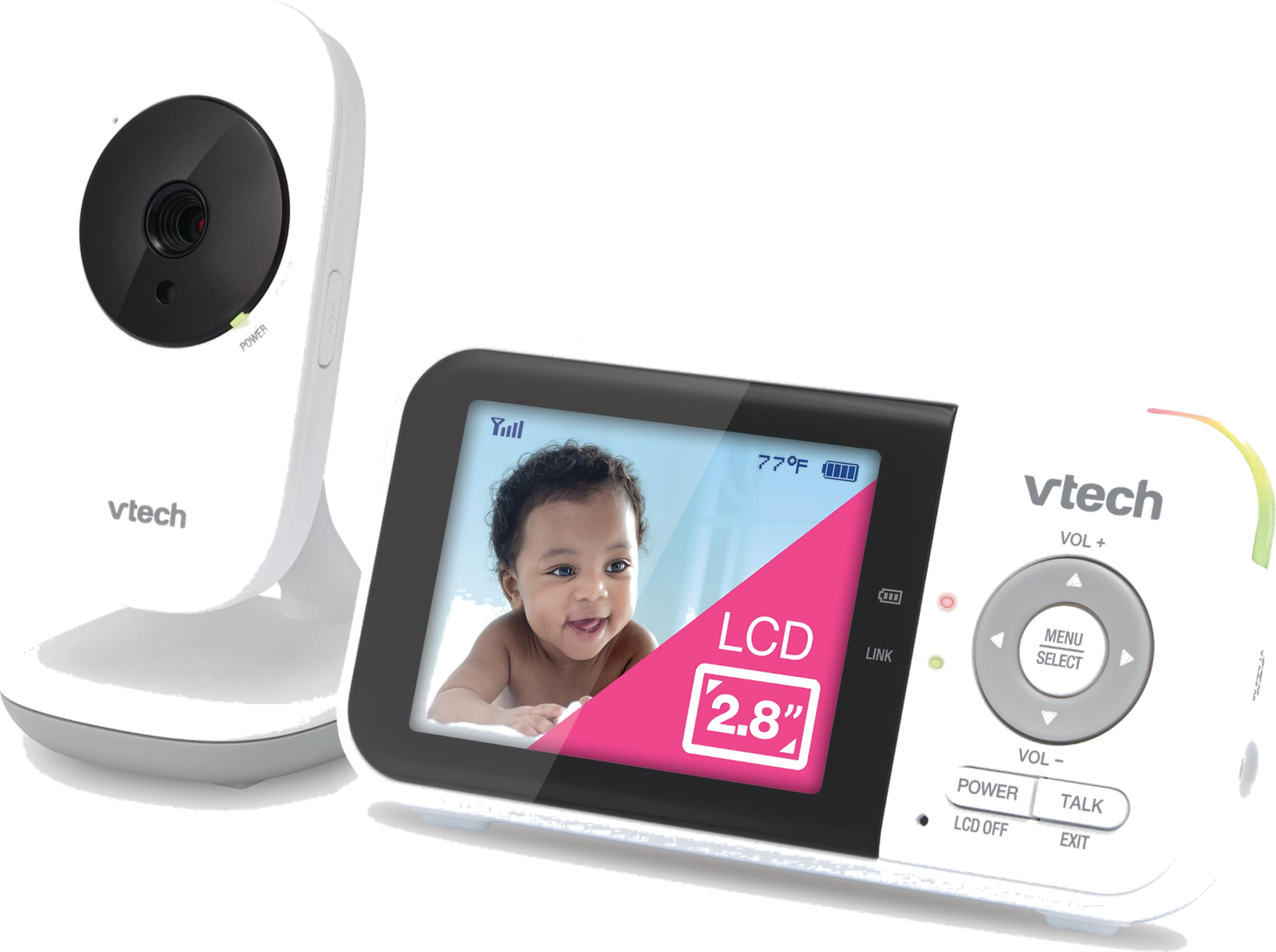
The VM819 answers a specific want: parents who need to see the room but refuse an app-based camera. It carries 4.3 ★ across 397 Amazon.ca ratings, 68% five-star, and pairs a 2.8-inch parent screen with infrared night vision, two-way talk, eight lullabies and a room-temperature readout — over VTech’s own secure RF link, with no account and no internet. Its buyers are emphatic about why they chose it: privacy and hack resistance were the deciding factor, not a bonus. Portability is the next most-mentioned positive — owners describe carrying the parent unit around the house, outdoors while gardening and into the car, helped by a screen-off sound-activated mode that wakes it when the baby stirs.
Pick this if: your baby sleeps in a crib and stays in one spot, you want night vision and a room-temperature reading, and you want all of that without an app. Its two documented frustrations are real and both land at night: the camera cannot be moved from the parent unit, and the menu beeps audibly on every selection.
⚠️ One number to read carefully. The DM221 carries 20,822 Amazon.ca ratings; the VM819 carries 397. Both averages are real, but a 4.3 drawn from 397 buyers is a thinner and much younger evidence base than a 4.5 drawn from more than twenty thousand. Where the two disagree below, weight them accordingly — and treat the VM819’s score as the one more likely to move.
Head-to-head on the four things parents actually care about
1. Do you actually need to see the room?
The VM819 wins — but only for a baby who stays where you put them. A screen with infrared night vision genuinely answers questions that audio cannot: is the blanket over their face, are their eyes open, did they actually settle. For about two dollars more than an audio-only unit that is a lot of monitor. The catch is that the camera is fixed. Its own five-star reviewers say so plainly — one wrote “you can’t move the camera with the screen. So where ever you place it, hopefully it’s in a good spot!” Another called manual positioning a non-issue for their baby.
So the round splits on your baby, not on the hardware. Newborn in a crib: the screen earns its money. Crawler, roller or climber: the screen shows you the corner they left, and the DM221’s ears tell you more than a stale picture does.
2. Night-time usability — the thing that actually wakes you
The DM221 wins. The VM819’s most-cited night problem is a beep: reviewers at four and three stars both flag that selecting anything from the menu “makes an annoying beep sound when you select the room, regardless of the volume being muted,” with one adding it is “great for disturbing sleeping spouses.” A three-star owner also reported that the lowest screen brightness is still far too bright, and that a blinking LED on the camera is aimed at the baby. The DM221 is not flawless here either — a four-star owner of 18 months wanted better control over “what actions will cause the screen to light up at night” — but it adds a vibrating sound alert, which is the feature designed for exactly this problem.
If you share a bedroom, or either parent is a light sleeper, this round matters more than the screen does.
3. Range, and what happens when the internet drops
A draw, and it is the reason to buy either of them. Both are rated to 1,000 ft line-of-sight and neither uses your home network — the DM221 over encrypted DECT 6.0, the VM819 over VTech’s own RF. Owners of both report the same real-world result: coverage that holds across a whole house and outside it. A VM819 buyer in a 2,400 sq ft home with “many thick walls” reported no connection issues; DM221 owners describe holding the signal from a second floor to a basement and out into the backyard. Buyers of both models say the same thing about outages — monitoring simply continues when the internet does not.
4. Price, durability and what the critical minority says
The DM221 wins on the numbers, by a margin worth noticing. The two are effectively the same price ($78.04 against $79.99 CAD at the figures recorded in August 2026), so this is not a budget decision. It is a risk one. About 11% of DM221 buyers rated it three stars or lower, against about 20% for the VM819.
What those unhappy buyers say differs. The DM221’s critics name hardware: a three-star owner’s second receiver stopped working within months and would not power on even after two battery replacements, and a one-star buyer reported a set that “worked once and then stopped.” That is a real reliability tail on a small minority of units. The VM819’s critics name design instead — the fixed camera, the beep, the brightness — which is more predictable, but also permanent, because no returns process fixes a design choice.
Verdict by use case
These two cost within two dollars of each other and share a network-free design, so the right answer is decided almost entirely by your baby and your bedroom — not by the scores.
When your baby sleeps in a crib and stays put
VTech VM819. This is the case the screen was built for. Night vision, room temperature and lullabies for about two dollars more is a genuinely good trade, and a fixed camera is not a limitation when the baby does not move out of frame.
When your baby rolls, crawls or climbs
VTech DM221. The VM819’s camera cannot be panned, tilted or zoomed from the parent unit — its own buyers raise this more than anything else. A picture of where your baby used to be is worth less than hearing where they are now.
When you share a bedroom, or one of you is a light sleeper
VTech DM221. The VM819’s menu beep cannot be silenced even with the volume muted, and its minimum screen brightness is reported as still too bright at night. The DM221’s vibrating alert is the opposite design instinct.
When you want to carry the parent unit around all day
VTech VM819, narrowly. Its owners describe genuinely taking it with them — room to room, into the garden, into the car — with a screen-off sound-activated mode that preserves battery. DM221 owners put their parent unit at roughly three to four hours off the charger and mostly leave both units plugged in.
When you want the safest bet on the evidence
VTech DM221. 4.5 ★ across 20,822 ratings, 89% at four or five stars, and half the share of unhappy buyers. The VM819 may well settle in the same place — but at 397 ratings it has not yet had to prove it.
When you want a camera you can steer, or check from work
Neither. Both are deliberately network-free and neither camera moves remotely, so a phone-based monitor is the category you actually want — and you would be trading away the privacy that is the whole point of these two.
The honest weaknesses we won’t hide
We have an aggregation rule: if a complaint shows up in helpful-vote-weighted critical reviews, it goes in the writeup. Buyers trust sites that show the downsides.
| Monitor | What you should know going in |
|---|---|
| VTech DM221 | There is a small but real reliability tail: a minority of buyers report a receiver dying within months, in one case surviving two battery replacements and still refusing to power on, and another reporting a set that worked once and then stopped. The parent unit runs roughly three to four hours off the charger, so most owners keep both units plugged in. Even satisfied long-term owners want better control over what lights the screen at night. And it is audio only by design — buyers who wanted to see the room have rated it down for that. Note also that it is a 120V North American unit. |
| VTech VM819 | The camera cannot be panned, tilted or zoomed from the parent unit, which its own five-star reviewers raise as the main caveat and which is a dealbreaker for a mobile baby. The menu beeps on every selection and cannot be silenced even when the volume is muted — repeatedly described as a night-time problem. A critical reviewer reports the lowest screen brightness is still far too bright, and that a blinking LED on the camera is pointed at the baby. Its 4.3 ★ and 68% five-star share both sit below the DM221’s, and rest on 397 ratings rather than twenty thousand. |
Read the full reviews
- Full VTech DM221 review — 20,822 parents, 4.5 ★, the range-and-reliability story in depth
- Full VTech VM819 review — 397 parents, 4.3 ★, the no-Wi-Fi video story in depth
- Best no-Wi-Fi baby monitors in Canada — the wider case for keeping the nursery off the internet
- Best baby monitors in Canada — where these land against the Wi-Fi options
Buy on Amazon Canada
Prices shown were recorded on Amazon.ca in August 2026 and move often — check the current price before buying. As an Amazon Associate we earn from qualifying purchases, at no extra cost to you; full affiliate disclosure here. Scores are summarised from verified buyer reviews, not from hands-on testing. No sponsorships, ever.
Frequently asked questions
Is the VTech DM221 or the VM819 the better baby monitor?
It depends on whether your baby stays in one place. The VM819 adds a 2.8-inch screen with infrared night vision for about two dollars more, which is excellent value if your baby sleeps in a crib and stays in frame. But its camera cannot be panned, tilted or zoomed from the parent unit, so once a baby is mobile the screen often shows an empty corner. The audio-only DM221 rates higher (4.5 stars against 4.3) across a far deeper base of 20,822 ratings versus 397.
Do either of these baby monitors need Wi-Fi or an app?
No. Both are deliberately network-free. The DM221 pairs over an encrypted DECT 6.0 link and the VM819 uses VTech secure RF transmission. There is no app, no account and no internet connection involved, which is the main reason buyers of both models say they chose them. Owners of both report monitoring continuing normally when their home internet drops.
Can you move the VM819 camera from the parent unit?
No, and this is the most consistent criticism in its reviews, raised by five-star owners as often as by critical ones. The camera stays pointed wherever you physically mount it. Buyers describe it as a known trade-off for a baby who stays in a crib, and as a dealbreaker for a mobile baby who rolls out of frame.
How long does the parent unit last away from the charger?
Owners put the DM221 parent unit at roughly three to four hours off the charger, so most describe leaving both units plugged in and switching them on where needed. The VM819 parent unit is the more portable of the two in practice: its owners describe carrying it around the house, outside while gardening, and in the car, helped by a screen-off sound-activated mode that wakes the unit when the baby makes noise.
Why does the audio-only monitor rate higher than the video one?
Two reasons, and one caution. The DM221 is judged on a narrower promise it meets well, and buyers repeatedly describe the audio as more sensitive than expected with range that covers a whole house. The VM819 carries two documented daily-use frustrations that pull its score down: a camera that cannot be moved remotely and a menu beep that cannot be silenced. The caution is sample size, since a 4.3 average drawn from 397 ratings is a thinner evidence base than a 4.5 drawn from more than twenty thousand.